
Tucked between Himalayan giants, Bhutan is a country that treats “progress” differently: forest cover is protected by its Constitution, monasteries are living schools, and national happiness is measured as seriously as GDP. If you’re planning travel to Bhutan for the first time, this guide gathers the small wonders and big policies that make the kingdom unlike anywhere else, with practical tips threaded throughout so you can turn curiosity into a real itinerary.
📚 Need some extra travel inspiration? Check out our first-timer’s guide to Bhutan for everything you must do. Once you’re ready to dig deeper, discover new off-the-beaten-path experiences in our detailed guide to Bhutan’s hidden gems.
The daily tourism tax (SDF) isn’t just a fee — it funds Bhutan’s future
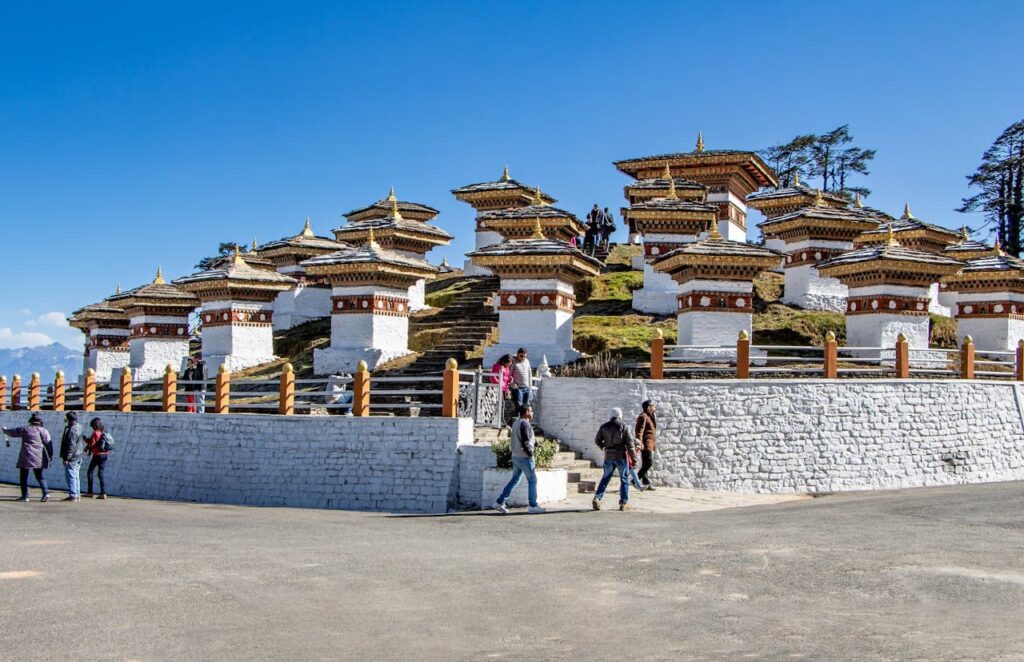
You learn this quickly on the road: the Sustainable Development Fee isn’t an abstract policy, it’s why the trailheads are tidy, the clinics stay open, and the dzongs (fortress monasteries) are kept in working order rather than left to crumble into postcard ruins. Through August 31, 2027, most visitors must pay USD 100 per person, per night, plus a separate visa fee. The money travels ahead of you, underwriting education, healthcare, conservation, and heritage. It’s the quiet scaffolding that keeps visitor numbers sensible and the country itself intact.
If you’re planning to travel to Bhutan, put the SDF at the top of your spreadsheet and then let it guide your rhythm. Festival weeks make the spend feel especially well used; if you’re weighing the best time to visit Bhutan, it’s best to look first at the tshechu calendar, then watch how the mountains, harvests, and road conditions slot around it.
You must travel with a licensed guide
For most foreign visitors, traveling in Bhutan still comes with one firm condition: you’ll need a licensed Bhutanese guide to accompany your journey. While you are allowed some independent movement in Paro or Thimphu, the general rule is that accredited guides are mandatory, especially if you plan to visit cultural monuments or travel beyond the capital region. This isn’t about hand-holding tourists; it’s part of how Bhutan protects fragile heritage sites, regulates visitor access, and ensures tourism dollars circulate beyond just the main hubs.
Think of your guide as much more than a chaperone: they are interpreter, storyteller, and navigator rolled into one. They’ll know which temples are under restoration, which bridge was lost in last year’s monsoon, and even which farmhouse still serves handmade buckwheat noodles. And if your trip takes you east of Paro and Thimphu (which it should, if you want to see Bhutan beyond its postcard icons), you’ll need to rely on their know-how for the insider routes and local connections that make the difference between a surface-level visit and a truly memorable journey.
Sustainability is constitutional (literally)
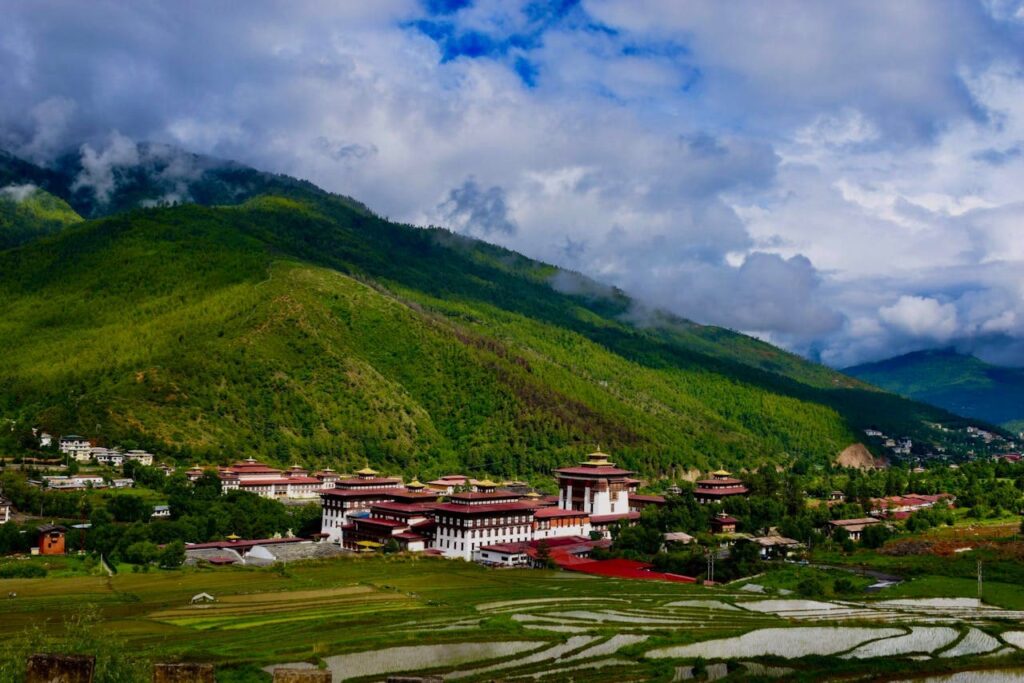
Few nations make it official, but Bhutan does. Its Constitution demands that 60 percent of the country remain forest for all time. In reality, the figure is even higher — around 70 percent — and more than half the kingdom is stitched together as parks and biological corridors. For travelers, the result is tangible: long stretches of road pass through pine and rhododendron forests unbroken by commercial sprawl.
Those forests are not just scenery. They are the reason Bhutan is one of the few nations in the world that is carbon-negative, its trees absorbing more carbon dioxide than the country emits, while hydropower in the valleys keeps electricity clean. And the payoff comes with the seasons: after the summer monsoon rinses the hillsides, the shoulder months reveal fresh air so crisp it sharpens the horizon, forests that feel like living cathedrals, and views that stretch clear across the Himalaya.
The three pillars: hydropower, agriculture, tourism
Bhutan’s mountain rivers aren’t just scenery; they are the backbone of the economy. Hydropower provides close to 100% of Bhutan’s domestic electricity and, depending on the year, 15 to 25% of GDP. It forms the bulk of exports, almost entirely to India. Projects like Tala, Chhukha, and Mangdechhu have become household names, symbols of how Bhutan transforms cascading rivers into both domestic energy security and hard currency. Yet dependence on hydropower also makes the economy vulnerable: rainfall patterns, climate shifts, and project delays can all swing revenues from year to year.
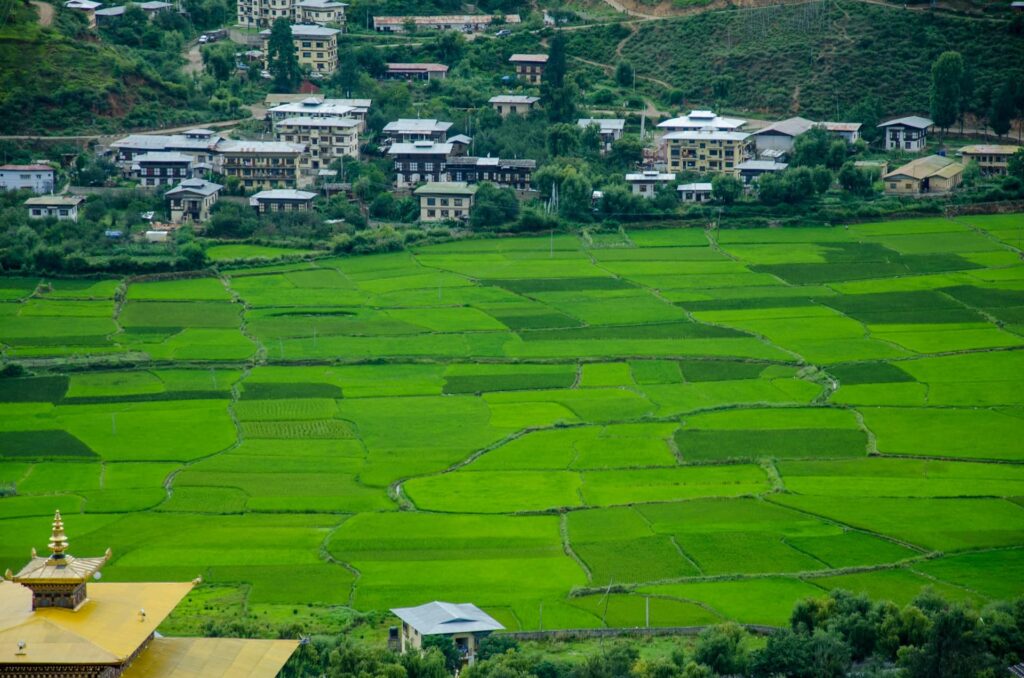
Agriculture still employs about 44% of Bhutan’s workforce. It is visible everywhere: red rice terraces filling the Paro Valley, fields of buckwheat across Bumthang, maize and cardamom farms in the humid south, and yak herders guiding their animals along high-altitude pastures. Farming here is often subsistence-based, shaped by altitude and monsoon rhythms, with rural life still defining much of the national culture. Community forestry programs and organic agriculture initiatives also reflect Bhutan’s policy of tying environmental conservation to daily livelihoods.
The third pillar, tourism, is deliberately managed under a “high-value, low-volume” model. Visitors pay the Sustainable Development Fee (SDF), ensuring that tourism revenues support healthcare, education, and environmental protection. While the sector contributes a smaller share of GDP compared to hydropower, it generates crucial foreign exchange, stimulates local businesses, and supports jobs across guiding, transport, and hospitality. Unlike hydropower’s volatility or agriculture’s heavy labor, tourism is framed as the face Bhutan shows the world, carefully balanced to preserve culture and ecosystems.
“Gross National Happiness” isn’t fluff (there’s an index for it!)

Gross National Happiness (GNH) may sound like a lofty idea, but in Bhutan it’s part of everyday living. The government measures well-being across nine domains — from health and education to culture, environment, and even how people spend their time. In 2022, the index rose to 0.781, with nearly half the population classified as “extensively or deeply happy”. Numbers aside, you see it most clearly on the ground: an entire valley dressed in brocade for a festival, a clinic in a remote village staffed by a nurse, or a farmer tending his red rice fields after morning prayers.
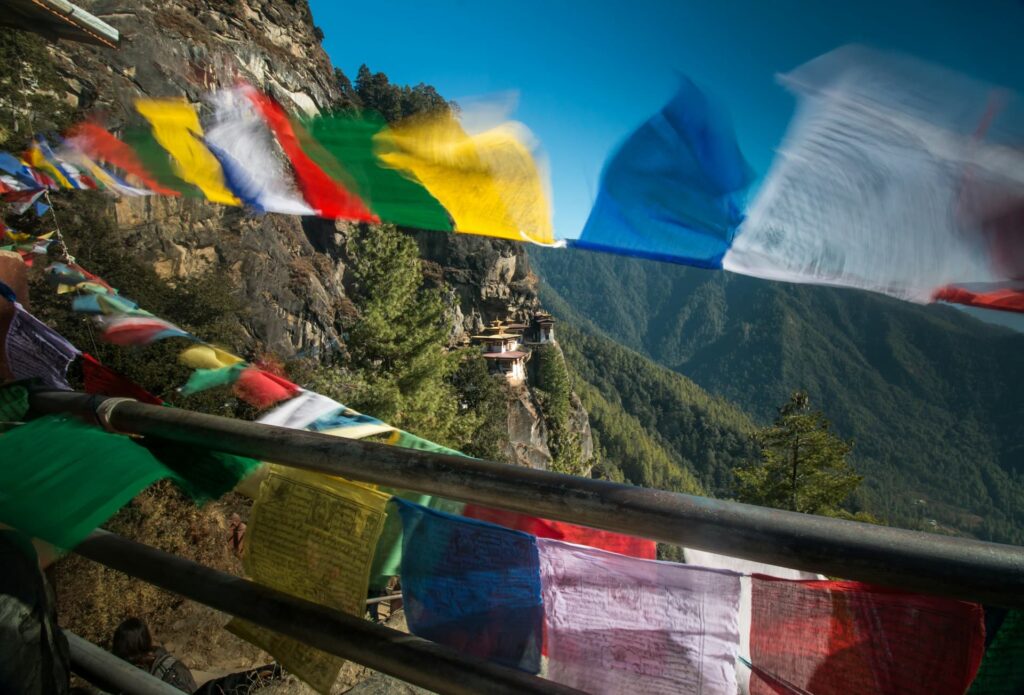
For travelers, the lesson is to give yourself the same room. Bhutan counts time as part of well-being, so don’t rush from sight to sight. Sit for a while by a prayer wheel as locals spin it on their way to market, wander through fields in the late sun, or simply pause to watch prayer flags snap in the wind. If you’re wondering about the best time to visit Bhutan, the real secret is this: leave space in your days, and you’ll feel why happiness here is measured in unhurried hours.
Monasteries are living schools of Vajrayana Buddhism
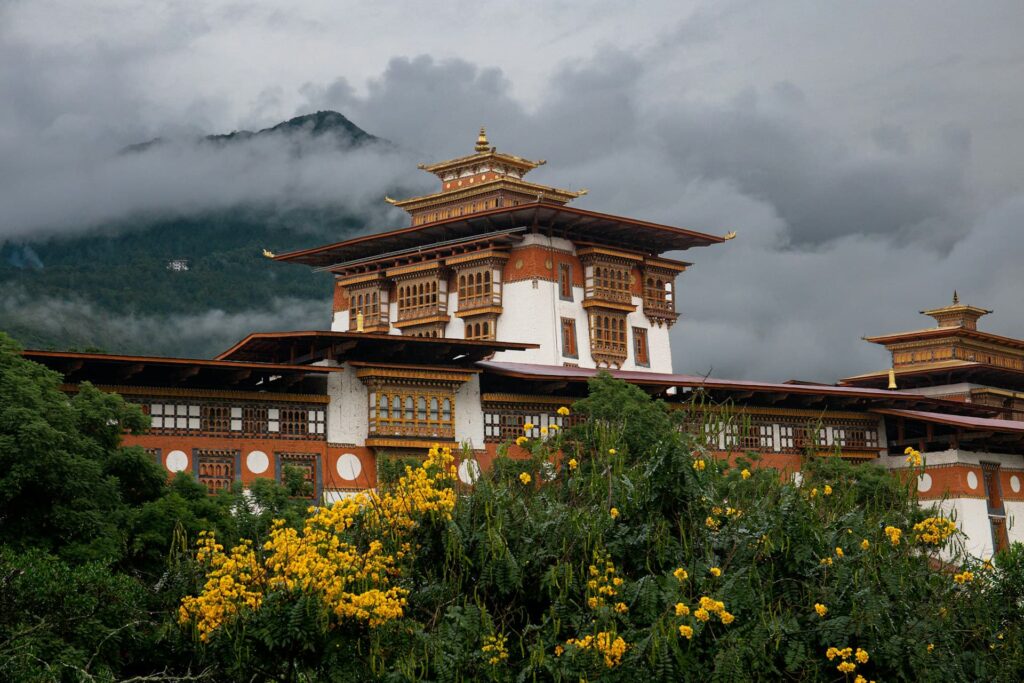
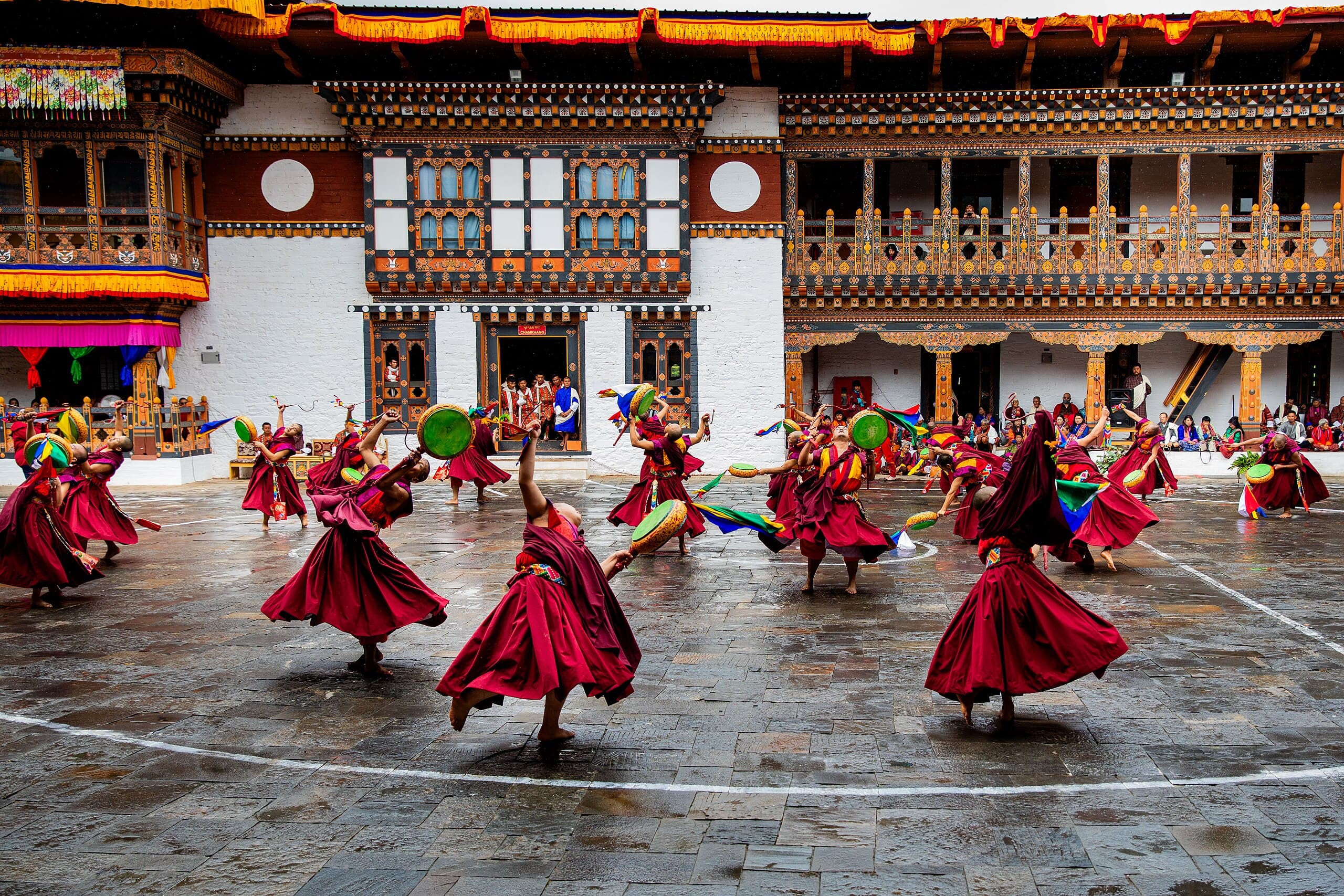
Dzongs aren’t frozen in amber. They creak and breathe: novices chanting in low rooms that smell of butter lamps, monks debating in courtyards, carpenters planing new beams for an old roof. At the center of it all is Vajrayana Buddhism, often referred to as the “Diamond Vehicle” or “Tantric Buddhism”. It is a unique branch of Buddhism distinguished by its use of esoteric teachings, mantras, and rituals designed to fast-track the journey toward enlightenment.
In Bhutan, the faith is not only widely practiced but also enshrined as the state religion, making the kingdom the world’s last stronghold of Vajrayana Buddhism. Its influence permeates every aspect of Bhutanese life, shaping daily customs, government institutions, artistic expression, and the very design of temples, monasteries, and architecture across the kingdom.
There’s a national dress code — and you’ll notice it
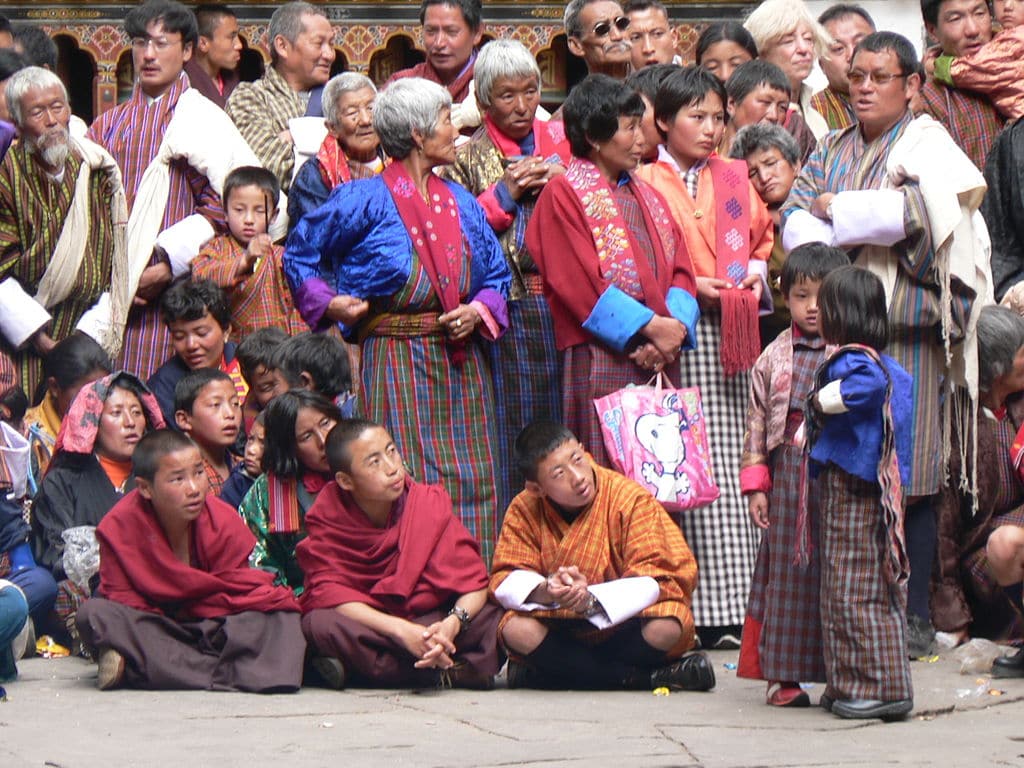
The etiquette code Driglam Namzha shapes public life. Men wear the knee-length gho, women the ankle-length kira; at formal events you’ll see the ceremonial kabney (men) and rachu (women) adding a cipher of color and rank.
Visitors to the kingdom aren’t required to wear national dress, but modesty matters in temples and dzongs: long pants/skirts and sleeves are a must. If a homestay host offers a gho or kira to try on, we encourage you to say yes. It’s a hands-on way to understand the architecture of a garment designed for mountain weather and monastery steps.
Bhutanese food is fearless with chilies
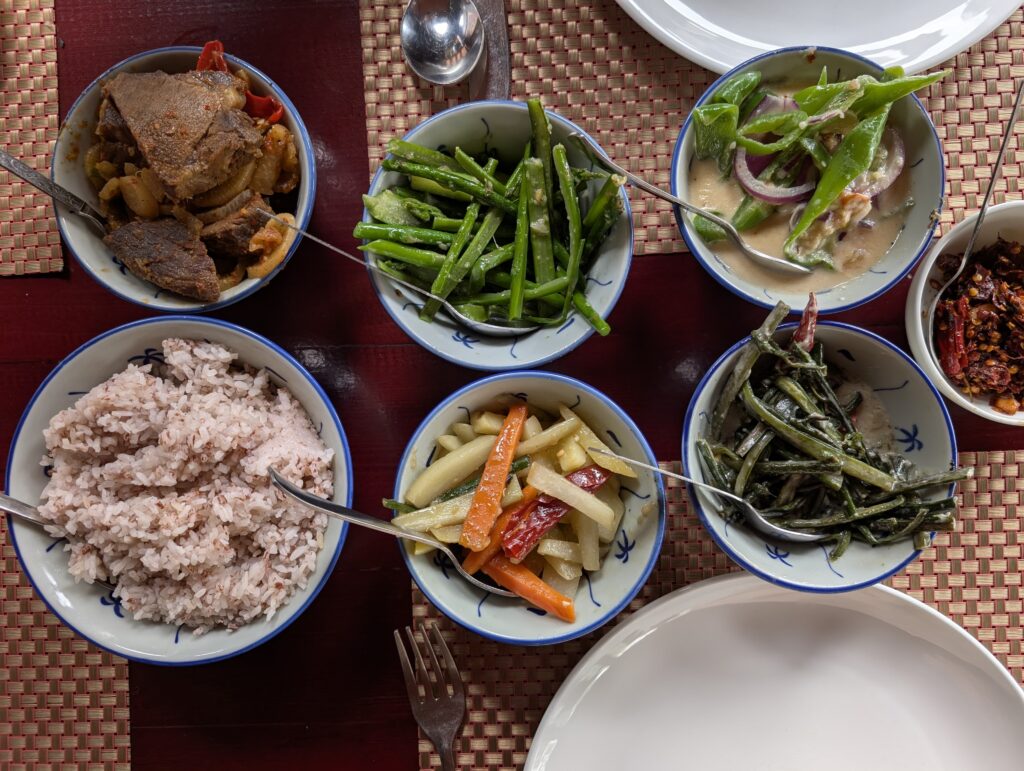
When you travel to Bhutan, you’ll quickly discover chilies are treated like a vegetable, not a garnish. Ema datshi, the kingdom’s national dish and most prominent staple, is made of chilies simmered with fresh local cheese. It comes in countless forms — you’ll find kewa datshi with potatoes, shamu datshi with mushrooms, and side bowls of ezay chili paste that brighten every plate of nutty red rice.
Meals shift as you move, and the seasons play a part in the farm-to-table culture. You’ll find buckwheat pancakes and noodles in Bumthang, yak butter and dried cheese in the highlands, and a fleeting parade of wild mushrooms after summer rain. Stop in a teahouse and you’ll likely find momo dumplings to snack on. Butter tea (suja) is less a drink than a nourishing embrace, thick with salt and yak butter, while ara, a homemade spirit, appears at family tables and festivals alike.
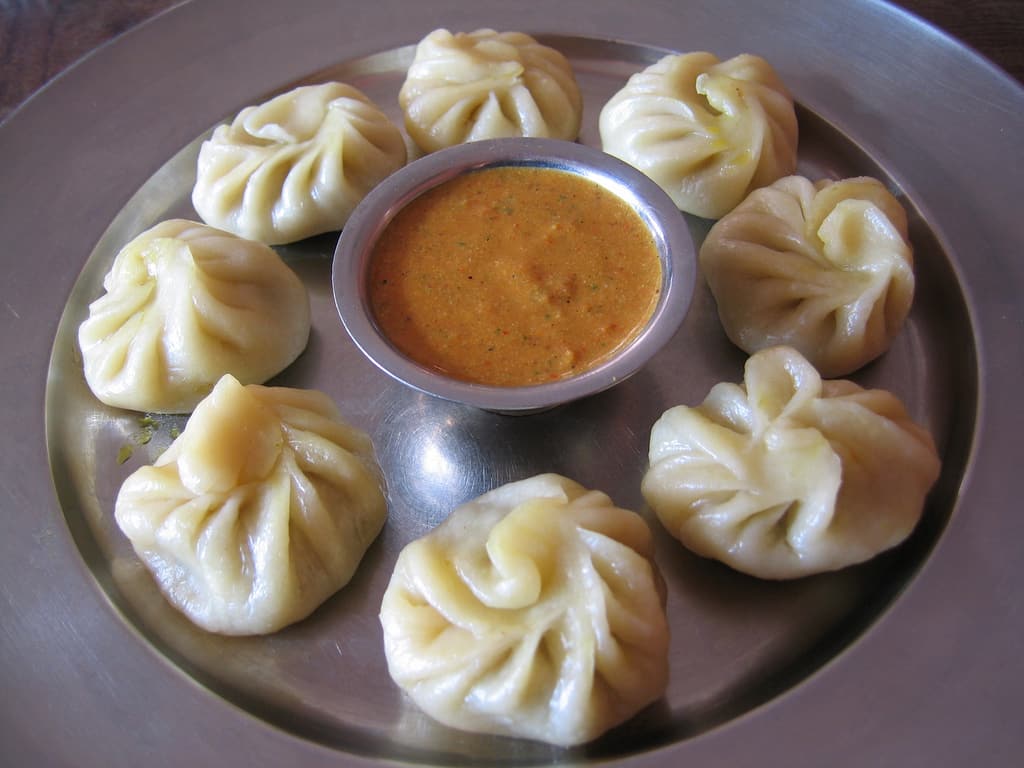
For travelers who plan trips around flavor, Bhutan’s kitchens mark the best time to visit. Spring tastes of tender greens and foraged herbs, summer brings river fish, autumn celebrates the harvest with smoky peppers and roasted maize, and winter is for slow stews and kitchens warm with storytelling. No matter the season, the meal is never just about the food — linger long enough, and there will always be another cup of tea, another momo, another tale shared across the table.
Thimphu’s claim to fame: the capital has no traffic lights
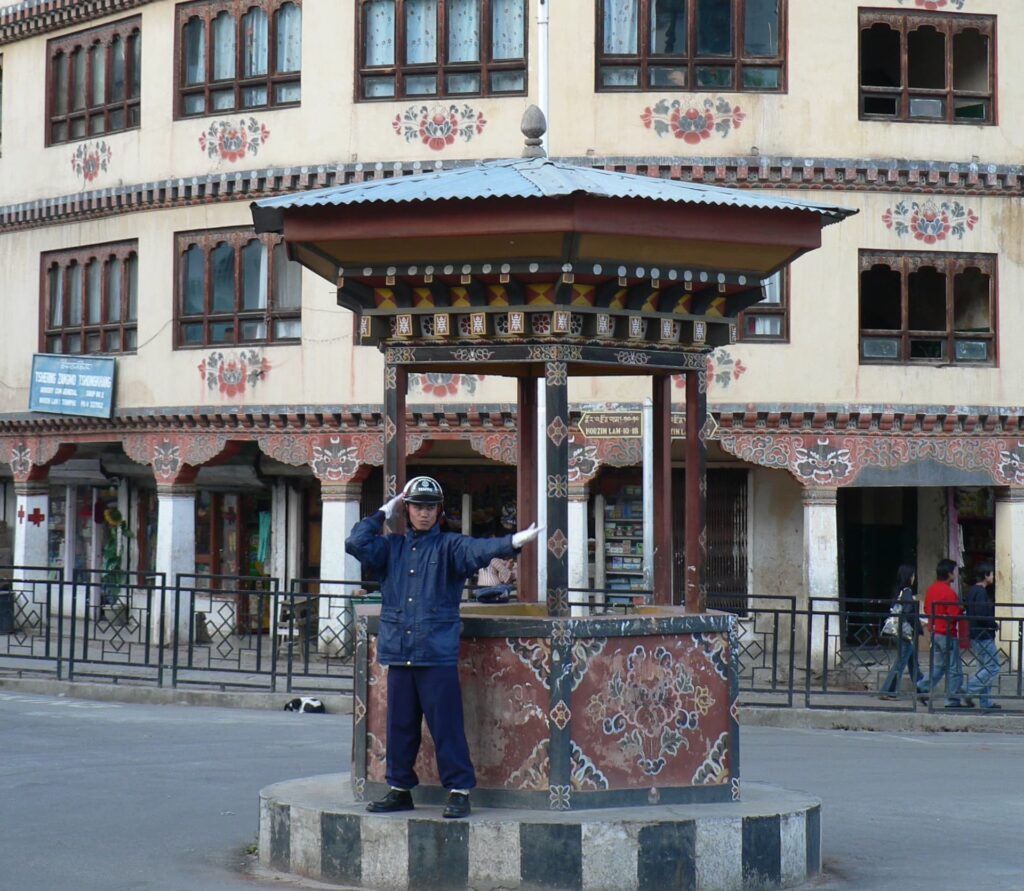
The rumor is true: Thimphu is indeed one of the few capitals in the world without traffic lights. A single light was briefly installed at a busy junction in the 1990s, but residents found it impersonal and disliked the congestion it created. It was removed, and since then intersections have been managed by white-gloved traffic police standing in small wooden kiosks.
Stand by the corner near Clock Tower Square and you’ll watch Bhutan’s preference for human-scale solutions play out in real time — palms lifted, drivers patient, pedestrians unhurried. It’s small, but it sets a tone. The capital’s pace is a notch slower than you expect for a seat of government, and a notch kinder too.
Money is friendly, but cash is still king
One unique fact about the currency in Bhutan is that the Bhutanese ngultrum (BTN) is pegged to the Indian rupee (INR) at a ratio of 1:1. Because of this, small INR notes are handy in the main cities and along main routes. Just don’t rely on rupees alone once you head into quieter valleys! Always carry Bhutanese ngultrum for rural shops, homestays, roadside snacks, prayer-flag poles, and monastery donation boxes. Pro tip: bring smaller denominations (₹10 – 100) for tips and offerings; big notes can be hard to break outside towns.
ATMs can be found around Paro, Thimphu, Punakha, Wangdue, and Bumthang (look for Bank of Bhutan, Druk PNB, T Bank). They work with major networks but can be offline during storms or power blips, so always carry spare cash. Hotels and larger restaurants increasingly accept Visa/Mastercard, yet terminals depend on connectivity; expect the occasional surcharge and always have a cash fallback when you travel to Bhutan.
Where snow leopards and tigers share the same mountains
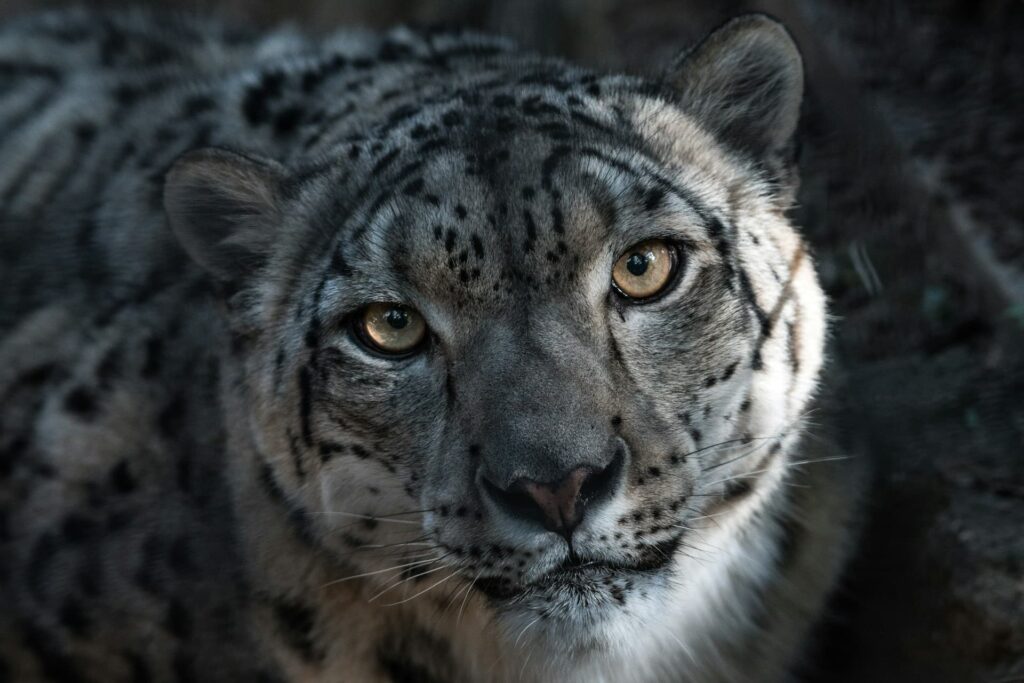
In Bhutan’s high-altitude forests and alpine meadows, camera traps have confirmed the presence of tigers at elevations above 4,400 meters — some of the highest tiger records in the world. These same ridgelines are also home to snow leopards, showing how the ranges of two apex predators overlap in Bhutan’s northern mountains.
Indeed, Bhutan’s wildlife is as much a part of its identity as its monasteries or mountains. The country’s commitment to conservation means that whole ecosystems remain intact, giving rare species the space they need to survive. In the river valleys, Bhutan protects some of the last habitats of the white-bellied heron, a critically endangered bird with just 24 individuals observed in the kingdom’s wilderness in 2025. Black-necked cranes migrate each winter to Phobjikha, drawing birdwatchers to clear skies and open fields.
There’s a 403-kilometer old pilgrimage trail that connects 9 districts
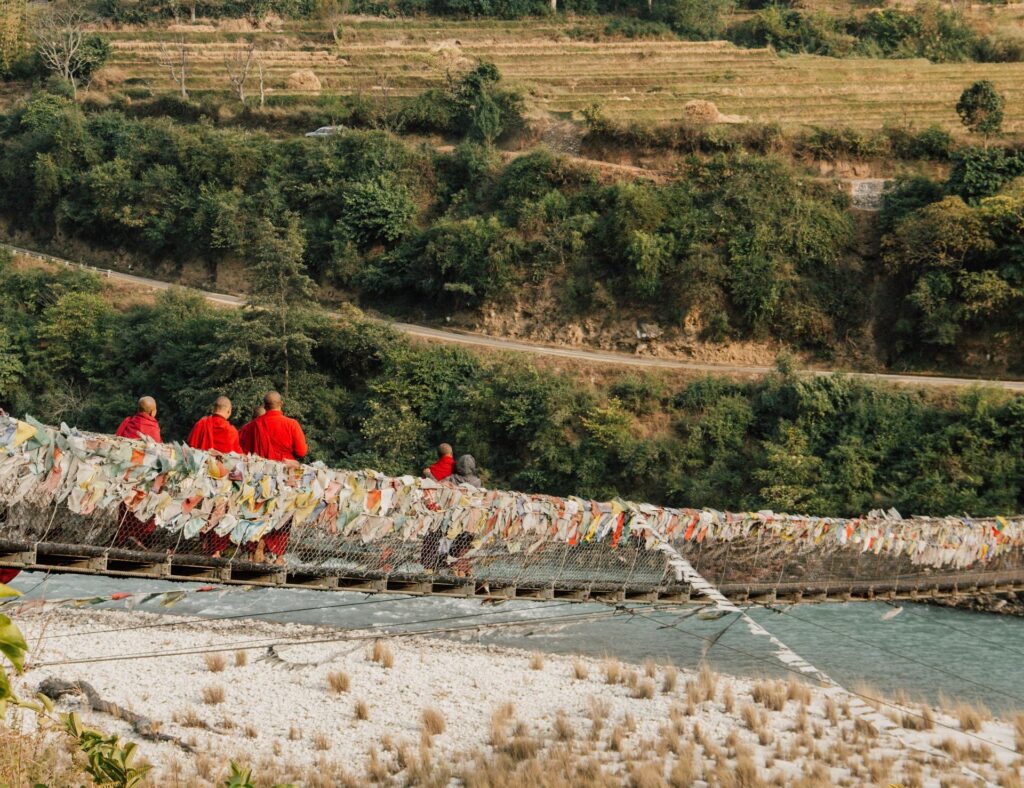
The Trans-Bhutan Trail isn’t just a hike. It’s 403 kilometers of incredible history stitched back together. Once the main artery for pilgrims, traders, and monks crossing the Himalaya, it was lost to time and roads until its grand reopening in 2022. Now fully restored, the trail cuts across 9 districts and 27 gewogs, with 170+ QR-coded waymarkers, 18 hand-rebuilt bridges, and over 10,000 stone steps that make you feel every century underfoot. From rice terraces in the west to oak, rhododendron, and pine forests in the east, it’s the only way to truly understand how Bhutan’s valleys link into a single story.
You can walk a single stage or commit to weeks on the move. Either way, the rewards are constant: teahouses when you need rest, locals quick with stories, and passport stamps that only make sense after dust, sweat, and distance have earned them. For travelers dreaming of foot-powered adventure, this is Bhutan at its most intimate — and if you want crisp skies, firm ground, and views that stretch forever, spring and autumn are the best times to go.
The “Snowman Trek” will test even seasoned trekkers
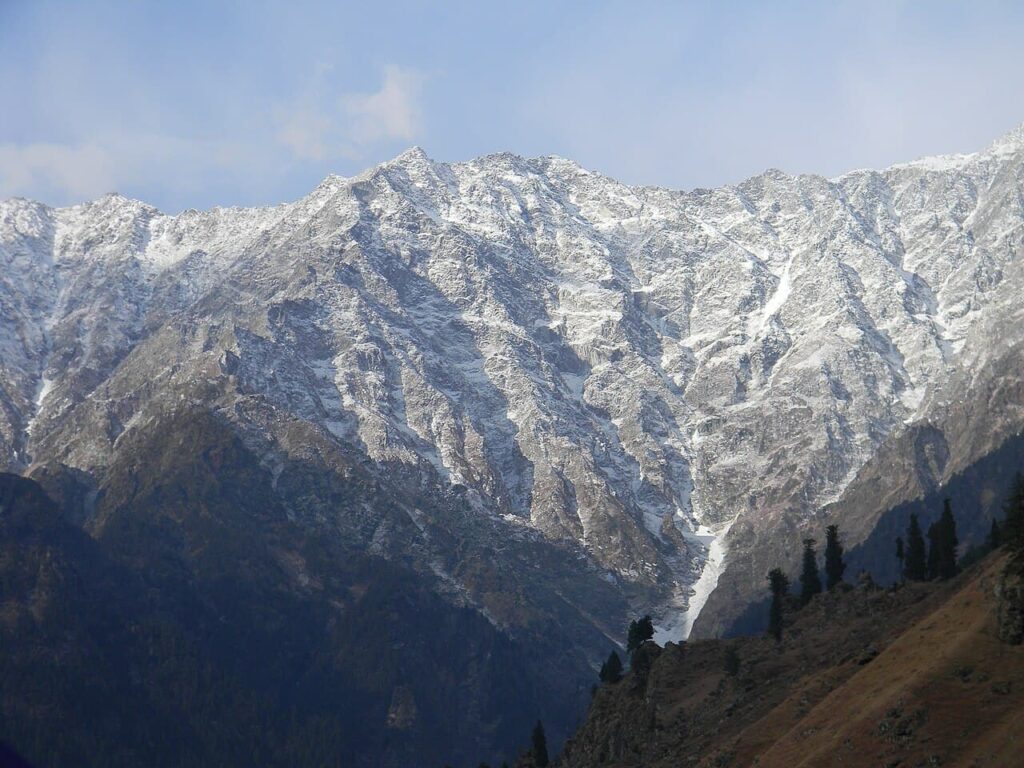
The Snowman Trek is the kind of journey that even seasoned Himalayan trekkers call a tough challenge. Stretching roughly 300 to 350 kilometers, it takes about 30 days to complete, with 11 high passes (several above 5,000 meters) and long stretches above 4,000 meters. The route threads deep into the Laya–Lunana region, where villages like Lhedi and Thanza feel like rare punctuation marks in a landscape of glacial lakes, windswept ridges, and silence so complete it startles you.
This is a trek where timing is everything. The weather window is short (usually September to October) and the logistics are too complex to improvise. It’s often said that fewer people have finished the Snowman Trek than the trek to Everest’s summit, and while the numbers are debated, the truth is clear: it’s one of the toughest long-distance hikes in the world. What matters most isn’t the bragging rights but the transformation — weeks of walking that teach you things about yourself. If you plan your travel to Bhutan around the Snowman Trek, train harder than you think you need, pack lighter than you want, and treat that chosen month as sacred.
Bonus practicals most guides skip
Power and plugs in Bhutan
Bhutan uses 230V/50Hz and sockets are Type D/F/G; pack a universal adapter so you’re not hunting at the last minute. If you’re juggling camera batteries during your travel to Bhutan, bring a small power strip.
Mobile & eSIM in Bhutan
Both Bhutan Telecom (B-Mobile) and TashiCell sell tourist SIMs in Paro and Thimphu; eSIM is supported by TashiCell and (in practice) by BT in phases. Coverage is limited in high valleys (which is half the magic). We encourage you to enjoy the beauty of the kingdom without relying on technology for a few days!
Best time to travel to Bhutan
The best time to visit Bhutan is generally March to May and September to November for blue skies, mountain views, and big festivals; June to August brings monsoon showers and lush valleys; the December, January, and February months are cold and clear (and perfect for sightings of black-necked cranes in Phobjikha). If your travel to Bhutan is festival-focused, anchor dates first by making your bookings well in advance, then build your route.
Why being prepared matters for first-timers
Bhutan rewards travelers who pace themselves. Knowing how the SDF works, when the best time to visit Bhutan really is, and understanding why tour guides are part of the experience will make your travel to Bhutan smoother and more meaningful. You’ll arrive ready, move respectfully, and spend time in the right places with the communities you came to see.
About TourHero
TourHero is a social travel platform that enables you to travel with like-minded people and fall in love with the journey. We work closely with handpicked local operators to ensure every experience curated is unique and exclusive to your travel group. Come with us on epic adventures and create memories that last a lifetime. Get started here!